Read the full newsletter here
Real estate taxation: Navigating complexity in an increasingly sophisticated environment
As Luxembourg’s tax environment grows increasingly sophisticated, real estate players must navigate greater uncertainty and make more informed strategic decisions. From carried interest to tax insurance, new tools are emerging to enhance attractiveness while securing complex transactions.
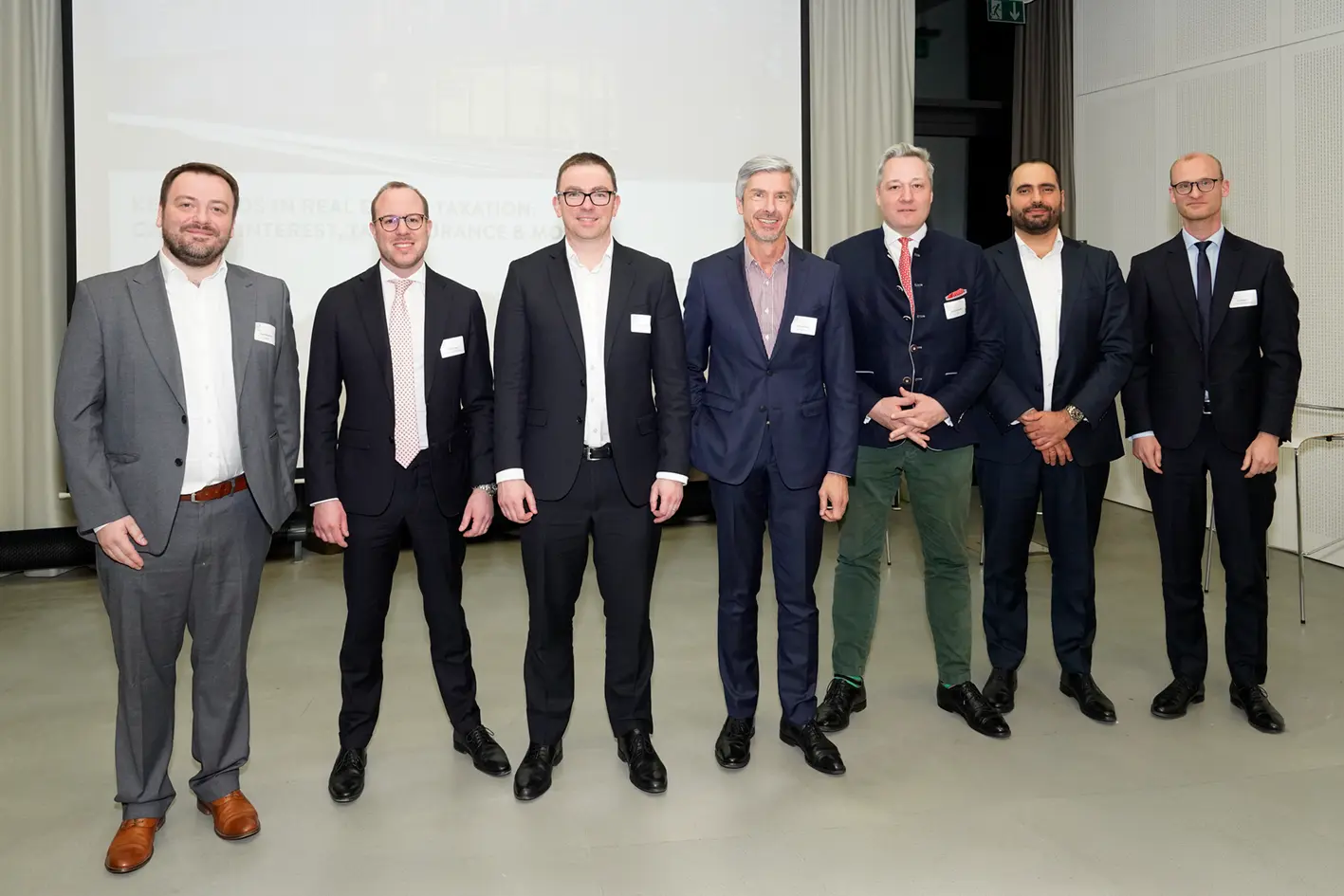
From left to right : David Mussche (Howden), Tom Hamen (Loyens & Loeff), Paul Taylor (Howden), Romain Muller (LuxReal), David Zackenfels (ALFI), Nissan Oz (Nuveen) and Franz Kerger (A&O Shearman)
Taxation rarely ranks among the most exciting topics. Yet it remains a key component of real estate investment structuring, particularly in an international context. It is also a critical lever in strengthening Luxembourg’s attractiveness as a leading financial centre. These were the key themes addressed by A&O Shearman and Loyens & Loeff during the conference “Key trends in real estate taxation: Carried interest, tax insurance & more”, organised by LuxReal on 5 March at the Forum da Vinci in Luxembourg.
An increasingly sophisticated tax environment
Opening the discussion, Tom Hamen (Tax Partner, Loyens & Loeff) and Franz Kerger (Tax Partner, A&O Shearman) highlighted a shared observation: Luxembourg’s tax landscape is becoming increasingly complex.
“In this environment, market players have a strong need for legal certainty. We are seeing a rise in tax litigation, driven in part by the growing sophistication of the tax authorities,” explained Franz Kerger.
This evolution is also reflected in the judiciary. The creation of a new chamber within the administrative court and the high quality of analysis in recent decisions are helping to clarify how tax rules are applied.
At the same time, reliance on tax rulings has significantly declined. Whereas they were once widely used, practitioners now increasingly rely on legislation, guidance and case law, sources that may still lack clarity in certain areas. As a result, structuring real estate transactions requires greater caution.
Case Law: A Growing Source of Tax Certainty
Recent tax case law in Luxembourg provides greater legal certainty and helps clarify investors’ strategies. In particular, a decision of the Administrative Tribunal dated 13 February 2026 regarding the reinvestment of proceeds from the sale of real estate property into equity participations in an intra-group context confirmed that the rollover regime can apply, provided the transaction is supported by valid economic reasons and properly documented. This ruling highlights the importance of economic substance and robust documentation in mitigating the risk of abuse of law, Franz Kerger explained.
In the area of VAT, a decision from November 2025 clarified that VAT liabilities attached to a real estate asset follow that asset and cannot be extended to other entities resulting from a restructuring. This case law underlines the need for a careful allocation of assets and liabilities in demergers or reorganisations, in order to avoid uncertainty regarding the allocation of tax liabilities.
Finally, decisions issued in 2024 concerning the carryforward of tax losses reaffirm that, while such losses cannot be transferred or “traded”, a company may change its business activity and offset those losses against future profits, even if derived from a different activity. This provides a degree of flexibility in restructuring strategies, while confirming the limits set by the tax authorities in relation to abuse.
Carried interest: a strengthened lever of attractiveness
Among recent developments, the new Luxembourg carried interest regime formed part of a central topic as part of a dedicated panel discussion. The regime aims to provide clarity in respect of remuneration of investment professionals, particularly those involved in investment fund management.
In practice, it offers a favourable tax treatment on performance-related returns, after a fund has successfully sold investments and repaid investors, a restricted number of senior management of a fund may benefit from such “carry” at clearly defined tax rates.
The objective is clearly strategic to form part of the Luxembourg toolkit. As highlighted by David Zackenfels (Legal – Senior Vice-President, ALFI), the Luxembourg “Carry” regime is designed to enhance Luxembourg’s attractiveness for key persons by attracting and retaining senior personal, particularly in front-office roles. He further added, that the carry regime provided simple and clear rules for asset managers to understand whether the regime could be of interest to them. Whilst the changes have been welcomed by the market broadly, they primarily serve to strengthen Luxembourg as a stable, innovative and competitive jurisdiction.
A competitive advantage… but not a deciding factor
That said, the regime alone is not a decisive factor. As noted by Nissan Oz (Lead General Counsel, Fund & Investment Structuring, Alternative Investments Europe, Nuveen), it should rather be seen as an additional benefit.
“Carried interest is more of a bonus, the cherry on top in a broader decision-making process,” he explained.
Decisions on where to locate talent depend on multiple factors, including regulatory stability, working environment, team organisation, as well as personal considerations such as family and quality of life. Tax is therefore an important component, but rarely the sole driver.
Nonetheless, in an increasingly competitive international environment, having a clear and stable tax framework remains a key asset in maintaining Luxembourg’s positioning.
Securing operations in an uncertain environment
In parallel, another tool is gaining traction: tax insurance. “We operate in an increasingly sophisticated tax environment, but how do we avoid surprises?” asked Tom Hamen.
As explained by Paul Taylor (Howden), tax insurance is designed to cover identified tax risks. Unlike W&I insurance, which addresses unknown risks, tax insurance applies to situations that have already been analysed but where some legal uncertainty remains.
It is particularly relevant in complex scenarios, such as cross-border investment structures or restructurings, where even a low-probability risk can carry significant financial exposure. In such cases, tax insurance provides downside protection against adverse outcomes, including reassessments, penalties and interest, complementing traditional tax advice. In a context marked by reduced reliance on rulings and limited case law, it often serves as a valuable “plan B”, helping to secure transactions and reassure investors.
A market gaining momentum
Once a niche solution, tax insurance is now gaining broader acceptance. The most sophisticated players, particularly large real estate investors and investment funds, increasingly integrate it into their risk management frameworks. “For some market participants, the question is no longer whether to use it, but when,” noted David Mussche (Howden).
While adoption remains uneven, the trend is clearly towards wider use. Easy access to preliminary, non-binding assessments and relatively fast execution timelines are contributing to its growing appeal.
In a more demanding and uncertain tax environment, tax insurance is gradually becoming a standard reflex in structuring complex transactions, alongside traditional legal and financial tools.
Back to the full newsletter here