Read the full newsletter here
Designing and building real estate for an uncertain world
As climate, energy and geopolitical risks intensify, resilience is becoming a new standard for the real estate sector.
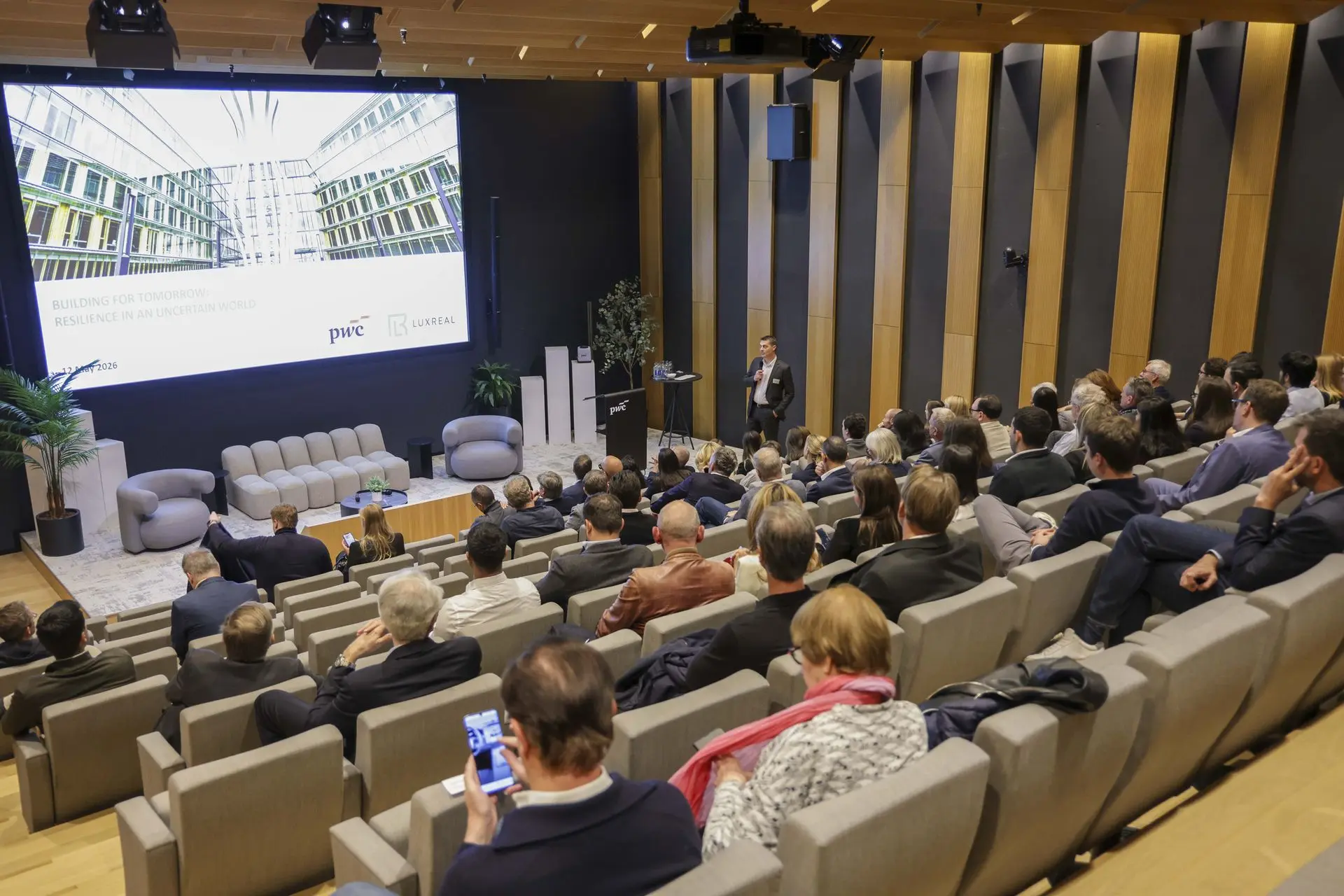
Heatwaves, floods, energy tensions, cost volatility and geopolitical instability… A succession of crises is gradually reshaping the fundamentals of the real estate industry. Organized in mid-May by LuxReal in collaboration with PwC Luxembourg, the conference “Building for Tomorrow: Resilience in an Uncertain World” brought together experts, engineers and finance specialists around a shared conviction: resilience is no longer a secondary consideration, but a key element in the design, operation and valuation of buildings.
“How can we build assets today that are capable of withstanding tomorrow’s uncertainties?” This question, raised by Pierre Wauthier, Partner, Corporate Finance – Real Estate Advisory at PwC Luxembourg, set the tone for an evening rich in insights and perspectives.
Climate Risks Are No Longer a Future Concern
Opening the discussion, Francesca Pogliani, Senior Sustainability Consultant at PwC Luxembourg, sought to bring the debate back to a very tangible reality.
“Climate risk is no longer a theory. It is a reality that we are already facing today,” she explained. More intense storms, prolonged heatwaves, heavy rainfall and increasingly frequent flooding: climate change is acting as an amplifier of existing hazards. For the real estate sector, this fundamentally changes how buildings must be designed and managed. “We now need to consider building resilience beyond energy performance and environmental certifications,” said Francesca Pogliani. “For many years, the focus was on carbon reduction and energy efficiency. Climate adaptation remained in the background. But that is changing rapidly.”
Today, climate risk assessments and adaptation measures are becoming increasingly important components in the evaluation of real estate assets. Above all, they require a much more granular approach, focusing on each asset individually. “A climate risk assessment must always be carried out at the asset level,” she emphasized. “A building in Luxembourg clearly does not face the same risks as an asset located on a Greek island or in a coastal area.”
The objective is no longer simply to construct high-performing buildings, but buildings capable of absorbing shocks and continuing to operate under degraded conditions.
When Climate Risk Becomes Financial Risk
The next question naturally follows: what impact will these risks have on the value of real estate assets? This was the focus of Jeremiah Dau, Actuarial and Risk Modelling Manager at PwC Luxembourg, who demonstrated how climate risk modelling can now translate physical risks into measurable financial impacts. “Climate risk modelling is about translating climate risks into financial impacts,” he summarized.
Climate-related threats are no longer viewed solely as environmental concerns. They are increasingly recognised as factors that directly influence profitability and asset valuation. Repair costs, rising insurance premiums, retrofit investments and rental income volatility all have very real consequences for investors, lenders and tenants alike.
“If you are a tenant and have to choose between a building protected against flooding and one that is not, in an area that has already experienced extreme events, the choice becomes obvious,” he pointed out. Using climate modelling tools, property owners and investors can now project risk exposure to 2030 or 2050, identify the most vulnerable assets and prioritize adaptation measures accordingly.
For Jeremiah Dau, this represents a new phase in real estate management—one in which climate risk becomes fully integrated into investment strategy.
Towards Buildings That Can Operate Independently
Resilience, however, is not limited to climate risks. Ian Forsyth, founder of Sustainable Building Solutions, broadened the discussion to include energy security and geopolitical risks. His presentation was inspired by a personal experience: the massive power outage that affected Portugal and Spain in April 2025.
“Everything stopped,” he recalled. “Traffic lights, trains, heating systems, water pumps, charging stations…” For him, the event exposed a vulnerability that remains largely underestimated: the energy dependence of buildings.
“The real question today is: what level of energy resilience do our buildings actually have?” he asked. According to Ian Forsyth, current standards are primarily designed to ensure safe evacuation during power failures rather than maintaining business continuity. Yet in a context shaped by geopolitical tensions, cyberattacks and growing concerns over Europe’s energy supply, this approach is no longer sufficient.
Reducing Exposure to Energy Market Volatility
“A resilient building is a building that can continue operating normally during a power outage,” he explained. Achieving this requires a combination of solutions: on-site solar generation, battery storage, islanding capabilities that allow a building to disconnect from the grid, and the progressive electrification of heating systems.
Beyond resilience itself, this strategy also helps reduce exposure to fluctuations in energy markets. “The market is moving from an energy-efficiency mindset to an energy-exposure mindset,” he noted.
In his view, buildings capable of producing, storing and managing their own energy will increasingly become more attractive, more stable and ultimately more valuable real estate assets.
Designing Tomorrow’s Materials Today
Another key topic explored during the conference was circular construction. Jeannot Schroeder, Director at Sweco, argued that the challenge is no longer simply to recycle existing buildings, but to design structures today that can be dismantled, reused and transformed in the future.
Using the Luxembourg Pavilion at Expo 2025 Osaka as an example, he illustrated this philosophy in a highly practical way. The temporary building was conceived as a genuine “material bank”, designed from the outset for future reuse. “If you think about reuse during the design phase, reuse later becomes relatively straightforward,” he explained.
Can We Anticipate Tomorrow’s Uncertainty?
Every aspect of the project was developed with this objective in mind: standardized dimensions to facilitate reuse in Japan, reversible assembly systems, recoverable foundation blocks and planned future applications for the materials used.
The same philosophy underpins Loop-Park in Bissen, a dismantlable parking structure designed with future adaptability in mind.
“We do not know how parking needs will evolve over the next fifteen or twenty years,” said Jeannot Schroeder. “The question is therefore: can we already anticipate that uncertainty today?” The project was designed so that it could eventually be dismantled and rebuilt for another purpose, while preserving the residual value of its materials and components.
Resilience as a New Quality Standard
Despite the diversity of perspectives presented throughout the evening, one conclusion emerged clearly: in an environment increasingly defined by uncertainty, resilience is becoming a new benchmark for real estate quality.
The ability to withstand climate hazards, secure energy supply, preserve asset value and anticipate future uses is no longer an optional consideration. Together, these dimensions are reshaping how tomorrow’s real estate is designed, developed and valued.
Back to the full newsletter here