Expo Real review: a selective recovery calls for a rethink of value creation
“Cautious optimism.” On Tuesday 13 October, a conference organised by LuxReal, Deloitte and Loyens & Loeff set out to capture the prevailing sentiment at the 2026 edition of Expo Real. While capital is flowing again and investors have returned to the market, they remain cautious and highly selective about the projects and assets on offer.
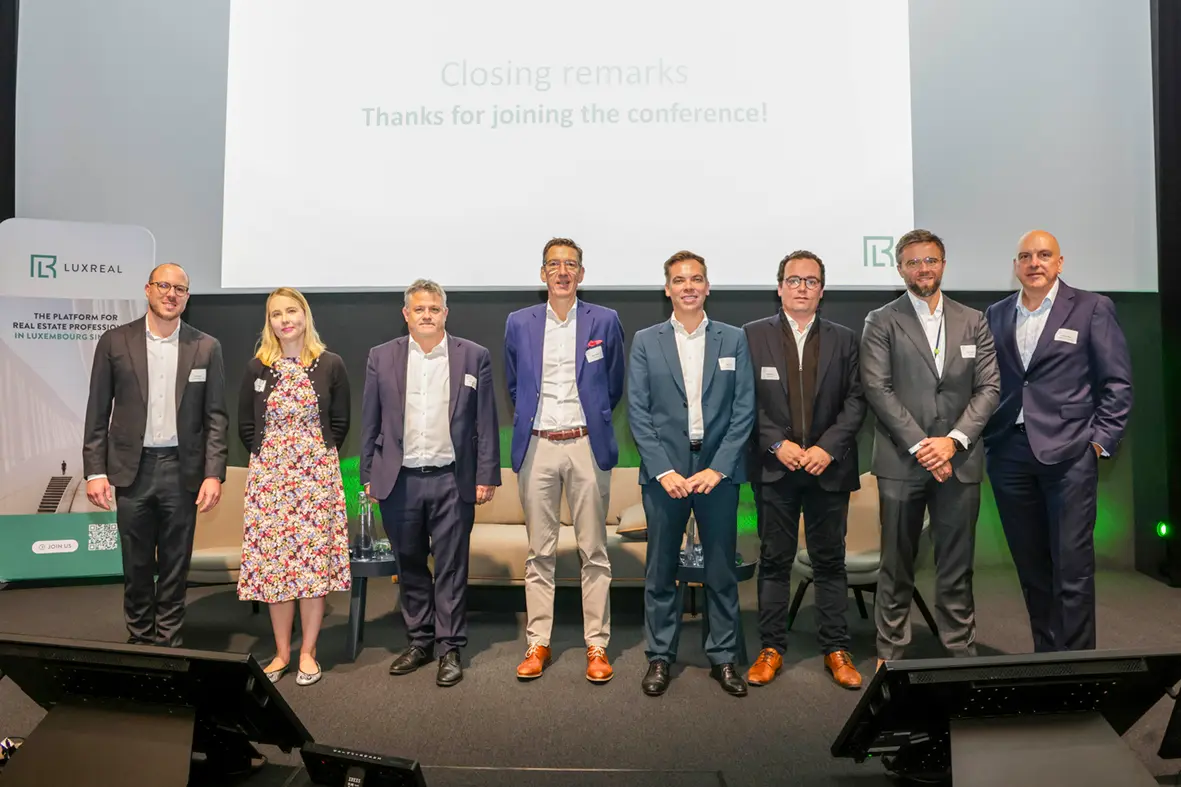
From left to right : Tom Hamen (Loyens & Loeff and luxReal), Elena Petrova (Deloitte), Jean-Luc Bermes (Spuerkeess), Marc Baertz (Inowai), Julien Lecler (Loyens & Loeff), Viktor Banus (Blue Colibri), Piotr Zatorski (Deloitte) and Andreas Meier (Deloitte)
“The real estate market has changed. Rather than hoping for a return to what we knew, we need to adapt to the new situation before us.” With these words, Andreas Meier, Partner at Deloitte Luxembourg and a LuxReal board member, welcomed participants to “Expo Real 2026 Debrief: European & Luxembourg Market Outlook”, a conference organised by LuxReal, Deloitte and Loyens & Loeff on 13 October.
The aim was to take stock of market sentiment following the trade fair, held in Munich from 5 to 7 October. With 40,000 visitors and more than 2,000 exhibitors from 74 countries, Expo Real is an ideal place to assess the forces shaping European markets. In two words, the mood could be summed up as “cautious optimism”.
Signs of recovery and new market dynamics
“We are seeing tentative signs of recovery,” said Marc Baertz, CEO of INOWAI, who was invited to share his assessment. “Construction costs remain very high, interest rates are rising and financing remains complex. However, market participants now seem to be taking better account of these new parameters.”
The era of cheap money is over. Today’s market dynamics are increasingly characterised by scarce capital, greater investor selectivity and the need for active asset management. For Piotr Zatorski, Senior Manager in the Alternative Investment Management practice at Deloitte Luxembourg, “the market is not really doing badly. Capital is moving again, but selectively, in specific asset classes and jurisdictions”.
Turning to the figures, Piotr Zatorski cited a 10% increase in investment across Europe between the first half of 2025 and the same period in 2026. The second quarter alone was the strongest since 2022. For 2026 as a whole, forecasts point to flat investment volumes or growth of around 5% compared with 2025.
Housing remains a preferred asset class
Against this backdrop, which assets are investors favouring?
“The appeal of housing, in its various forms, continues to grow, supported by structural demand,” explained Piotr Zatorski. This interest should benefit Luxembourg, where the residential market remains tight. “Luxembourg does not have a demand problem here. The issue is more about supply and affordability,” continued INOWAI’s CEO. One obstacle to residential investment in Luxembourg lies in the legislation, particularly the legal cap on annual rent at 5% of the capital invested in unfurnished housing. “We have been in contact with investors interested in opportunities in Luxembourg who have questioned us about this restriction on returns and their potential growth,” explained Marc Baertz.
He also highlighted the limited local institutional investor base and the tendency of foreign investors to retreat to their domestic markets during a crisis. “Given Luxembourg’s circumstances and challenges — high costs, scarce land and financing difficulties — we should consider creating a Luxembourg fund that could support residential development,” he said.
Continued interest in offices
Offices also retain a place in investment strategies, although there are significant differences between assets. “Large companies are looking for modern, flexible offices that offer services and better energy performance. Meeting these expectations means owners must keep their buildings aligned with market standards and give occupiers tangible reasons to choose them,” explained Marc Baertz. Secondary assets are facing greater difficulties in the current market.
Other asset classes, such as infrastructure, particularly data centres, are gaining momentum. However, the supply of investable assets in these segments remains limited in Luxembourg.
Market conditions call for caution
Although capital is flowing again, a survey conducted ahead of Expo Real shows that investors are particularly cautious and less optimistic than at the previous edition. “This reflects the ambivalent mood at the trade fair. Caution does not, however, mean there is no activity,” continued Piotr Zatorski. “It is reflected above all in greater selectivity.”
As Marc Baertz explained, this caution can be attributed to several developments, including an expected rise in interest rates, sharply higher construction costs driven partly by energy prices, and restrictive financing conditions. “The paradox is that these increases weigh on new development,” he said. “Despite clear demand, future supply remains limited. This could feed through to rents for highly sought-after prime assets, while secondary assets could face greater difficulties.”
The need for active asset management
An asset’s quality depends on several factors: its location, modern technical specifications and the services offered to occupiers. “Maintaining a building’s return, particularly outside central locations, requires investment to keep it up to standard. Active asset management is becoming essential. Returns now depend directly on the cash flows generated by the building, and less on yield compression,” explained Marc Baertz.
New development opportunities may therefore lie in transformation projects rather than new construction. This could involve converting offices into residential buildings or upgrading secondary assets. Here too, possibilities are constrained by the regulatory framework, particularly municipal general development plans (PAGs). “We need greater flexibility,” continued Marc Baertz. “As I said, the new source of value is active asset management. In my view, this is where value creation will come from over the next 24 to 36 months.”
An evolving buyer base
The two presentations were followed by a panel discussion that echoed this sense of “cautious optimism”. According to Julien Lecler, Partner in the Real Estate practice at Loyens & Loeff, investor caution is linked in particular to uncertainty over interest rates, valuations and the geopolitical situation, which slows transactions and makes them more complex. “As institutional investors become less active, family offices and French real estate investment vehicles known as SCPIs are playing a greater role among buyers, helping to sustain activity in Luxembourg,” he explained.
Capital is available… for the right opportunities
Viktor Banus, Conducting Officer for Portfolio Management at Blue Colibri, expressed optimism about Luxembourg’s long-term prospects. In his view, capital is available for the right opportunities. Jean-Luc Bermes, Deputy Head of Corporate Banking at Spuerkeess, highlighted the growing importance of high-quality data in accessing finance. “Banks are still lending,” he commented, “but with stricter requirements. Strong proposals can still secure financing, but lenders are asking for more equity, solid tenants and well-supported valuations.” Optimism, indeed, does not rule out caution.