Roland Kuhn
“Building more homes is everyone’s responsibility”
Named Personality of the Year at the latest Paperjam x LuxReal Real Estate Awards, Roland Kuhn is keen to share this recognition with those who have supported him throughout his career, both in serving his company and in championing the craft sector. The entrepreneur holds a firm conviction: achievements are collective and require people to work together in trust. Faced with a crisis he considers unprecedented, he calls for everyone’s efforts to be mobilised to keep moving forward.
What does this Personality of the Year award mean to you?
I was deeply moved when I received the award. Of course, it is gratifying, and I thank those who thought of me when deciding whom to honour. However, I do not see this award as a purely personal honour. I have never worked for my own ego. I have always worked for the cause. What matters is achieving something together, making the craft sector’s voice heard and raising its profile. Whether in a company or in professional organisations, you never achieve things alone. Throughout my career, many people have stood by me, supported me and given me all the energy I needed to commit myself. And I thank them. This award belongs to them too.
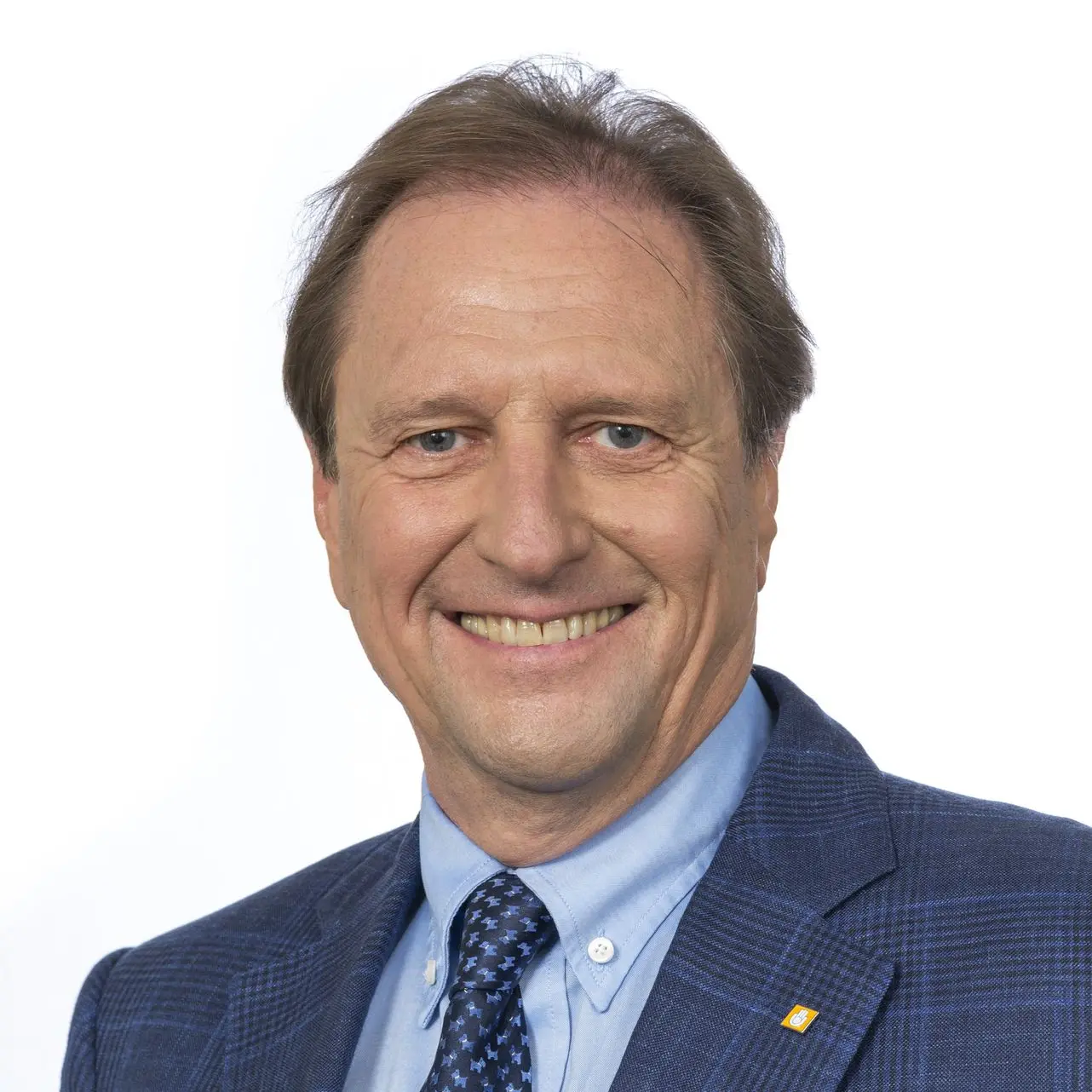
Roland Kuhn
Kuhn Construction
Kuhn has a history spanning more than 125 years, serving Luxembourg’s construction industry…
Even longer, in fact, if we go back to the family’s roots. At the centenary celebrations of the company, which was founded in 1897, some guests brought us an account from the newspaper A-Z that dates back even further. One of my ancestors, Mr Johann Kuhn (Bätztter) from Clausen, was already working as a plasterer nearly 173 years ago (Meister-Bau Bätztter). During the renovation of a café on Place d’Armes, he is said to have hidden a letter in a cigar box inside a wall; it was later found. That says a great deal about the family’s commitment to the craft sector. I am the sixth generation to lead the company.
What responsibility does that entail?
A considerable one, as it does for any business leader. When I chaired the Chamber of Skilled Trades and Crafts, I often spoke about a company’s social responsibility and its responsibility to society, particularly towards its employees, but also towards the economy and the country. However, talking about it is not enough. You also have to take personal responsibility.
Responsibility means, first and foremost, ensuring that everyone can take pride in their work, while also being treated with respect and feeling secure, with solid prospects for their employment. For me, the company, with its more than 400 employees, is one big family.
That soon raises a very practical question: what would happen to the company and its employees if something happened to me? As I have no children, I had to explore other ways of preparing for the future.
Was that concern what led you to join the Giorgetti group?
Yes. It was important to ensure the company’s long-term future and safeguard our employees’ jobs. Joining forces with Giorgetti, which is also a family business, reflected that desire to secure a future for our teams.
Looking back, I am very happy with that decision. The group has developed enormously, we have a good team and we get on very well. It was important to me to find a structure in which the company could continue to grow.
The craft sector is central to your work and commitments. Why is it so important to champion it?
Because it is everywhere, and it is essential! We wake up with the craft sector and go to bed with it. In the morning, when you sit on a chair at a table, you are already benefiting from a joiner’s work. The bread you eat is the result of a baker’s work. What you put on it may come from a butcher. And when your heating breaks down on 31 December, just as you are expecting family or friends, you are very glad to have a heating engineer come and repair it. These trades are part of our daily lives, sometimes without our even realising it. That is what we try to remind people of through our work: the craft sector is indispensable to our lives.
“The craft sector is indispensable to our lives”
And yet these trades do not always receive the recognition they deserve…
That is a fact. It starts with the way people view them, particularly within families. You still hear children being told that if they do not study at school, they will end up working with a shovel and a pickaxe. But working for a construction company does not mean you learn nothing!
Today, a building is highly technical: low energy consumption, photovoltaics, home automation… These are interesting trades that require a tremendous range of skills.
An apprenticeship is no less valuable than a university education. We need both. Craft workers use their hands, but also their heads. And they can take pride in what they achieve. Seeing what you have built and knowing your customers are satisfied brings enormous satisfaction. There is a dignity to the expertise in the craft sector that is not sufficiently recognised. In Switzerland and Austria, for example, skilled trades are held in much higher regard. The craft sector demands specific skills and rigorous training. Luxembourg’s craft sector is also renowned for its quality. In construction, passing on these skills was one of the main reasons we established our training centre, the IFSB (Institut de Formation du Secteur du Bâtiment), as well as the GTB/PAR Centres of Competence set up by the Fédération des Artisans, which support the development of our trades. In the age of AI, skilled craft jobs will not be easily replaced.
Over several decades, you have seen Luxembourg grow dramatically in scale. What strikes you most about that development?
The country has developed enormously. There are major projects, but smaller jobs remain just as necessary: repairing a roof, replacing a few steps or adapting a driveway entrance. We need all of these.
What has also changed, in my view, is the relationship between the various parties. In the past, departments were smaller, you knew the person you were dealing with, and a phone call was often enough to move things forward. There was more trust.
A company is a partner. A construction project is a collective effort. The architect, engineer, public authorities and contractor all work for the same client, whether public or private. It is essential to be aligned and share the same determination to move forward, doing good work and respecting one another. That trust, which has sometimes been lost, is very important.
“A construction project is a collective effort that requires trust”
The sector is currently going through considerable turbulence. How do you view this crisis?
It is unprecedented in more ways than one. In my entire career, I have never experienced anything like it. The financial crisis of 2007–2008 was significant, with enormous repercussions; banks had to be rescued by the state. But ultimately, many clients turned to property, investing in bricks and mortar. Today, the situation is paradoxical. Housing construction has slowed sharply and has almost come to a standstill. The need is still there, but investment has disappeared.
“The current crisis is unprecedented in more ways than one.”
According to STATEC’s figures, we should be building between 5,000 and 7,000 homes a year. In recent years, we have built fewer than a thousand each year. What we do not build now eventually creates a shortfall. And at some point, the backlog becomes very difficult to make up.
What measures are needed to get construction moving again?
We must acknowledge that the government is making considerable efforts, particularly to build and buy affordable housing. That is necessary. But we need homes of different types and sizes. We must allow the full range of housing to be developed.
To achieve that, we need to draw on investors. They include private individuals, of course, for whom various measures have been introduced, such as accelerated depreciation. However, these measures should take greater account of the diversity of needs. Accelerated depreciation does not apply to any property where the value of the construction component exceeds €600,000. The idea would be to allow depreciation at 6% on the first €600,000 and at 2% on the value above that amount. That is not currently the case. Accelerated depreciation is a real lever for encouraging property investment and supporting the creation of new homes.
But we must not overlook legal entities, including Sociétés Civiles Immobilières (property-holding partnerships), which cannot benefit from the same measures. It is important to find ways of mobilising capital held by companies that could be invested in rental housing. Further measures could still be taken to that end.
Beyond the government’s role, what needs to happen to bring the sector out of the crisis?
Banks also need to play their part by making financing more accessible. More broadly, all parties need to explore, both individually and collectively, ways of moving projects forward. Inaction also comes at a cost. Today, the priority is to build. This is essential if we are to preserve the jobs of those currently working in the sector and meet the country’s needs. Since the start of this crisis, the sector’s workforce has already shrunk. The skilled trades in construction were estimated to employ 60,000 people. That figure is now thought to be down to just 55,000. We absolutely must maintain that minimum workforce to ensure the sector can continue operating in the long term. To do that, we need to build, whoever does it. We have no choice. What matters is that homes are built and companies can work, so that clients can find somewhere to live. We have the skills and deliver very high-quality work in Luxembourg. We must preserve that.
“We must preserve jobs in construction. To do that, we need to build.”
There is indeed frequent talk of the risk that this crisis will weaken the country’s ability to build in the future. Do you see that as a real risk?
As an entrepreneur, you find solutions. We have always sought to encourage people to enter these trades, because many employees are reaching retirement age. Yet it is not easy today for those who come to work in Luxembourg every day from Belgium, France and Germany, sometimes facing long commutes. Their contribution is considerable. We must be grateful to them.
Looking ahead, we also need to explore other ways of attracting talent from further afield. I am thinking in particular of Brazil, where young people trained in skilled trades might be interested in a job in Luxembourg. But we still need to be able to welcome and house them. In this respect, the legislation known as “aides à la pierre” helps facilitate the construction of housing for our employees.
Despite everything, are there reasons to be optimistic?
Yes, I am always optimistic. I know we are surrounded by people who can think things through and find solutions. But we must not sit back and do nothing. We need to take the situation seriously and explore every avenue that could restore the desire to move forward and invest. We will not know immediately whether each of them will bear fruit. But we must at least try.
That, too, is what being an entrepreneur means: finding a way to make things happen. We need everyone to contribute to this effort to get projects moving again.
When you look back on your career, what are you most proud of?
Having surrounded myself with capable people of integrity, both within the company and in my other commitments. They helped me bring ideas to life, not just my own, but also ideas we shared.
We enjoyed some very good years, and we were fortunate. But we also had to do good work, motivate our teams and put in the effort. Nothing happens by itself.
I am happy with what we have achieved and with the relationships we have maintained. Even when our professional paths went separate ways, we often remained on good terms. That matters a great deal to me.
Throughout an entrepreneur’s career, the people around you and your friendships are also essential. It is important to nurture them.
How do you now envisage your “active” retirement?
Active indeed. I am still at the company every day. I remain involved at the political level, working on behalf of the craft sector. I still love my work. I always have. Even in difficult times, I have never felt that I had to drag myself to work.
I would also like to devote more time to music, another passion of mine. Several years ago, I set up a recording studio. It has supported many talented artists from Luxembourg and elsewhere, including Vaya Con Dios and Maurane. Today, I would like to help young musicians who have talent and the desire to move forward, giving them the means to produce something.
I have also had a passion for model aircraft since I was twelve. At first, they were made of wood and balsa. Today, they are turbine-powered aircraft. It still gives me just as much pleasure. You see, that is craftsmanship too!