Read the full newsletter here
Stuck market, strong demand: Luxembourg’s real estate paradox
The Luxembourg residential real estate market remains stalled, while several European countries are beginning to recover. This was the assessment shared by Alessandro Rizzo, CEO of EuroCaution, at the opening of the Real Estate Outlook conference, held on March 17 and organised by LuxReal in collaboration with KPMG. While demand remains strong, private buyers are largely excluded from the market due to a persistent gap between property prices and purchasing power. Today, fewer than 14 % of the population would be able to purchase a property under current market conditions.
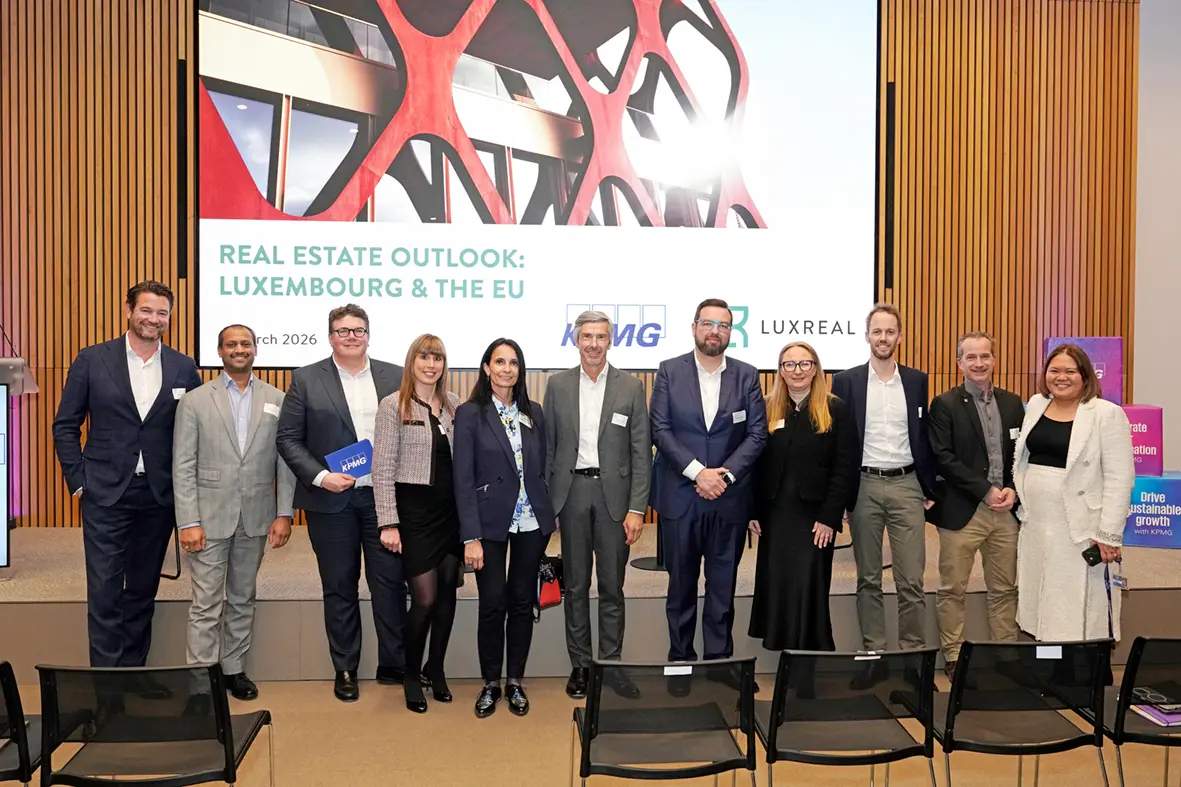
From left to right : Joost Knabben (Vistra), Joseph de Souza (KPMG Luxembourg), Antoine Badot (KPMG Luxembourg), Marion Knaebel (KPMG Luxembourg), Martine Gerber-Lemaire (Dentons Luxembourg), Romain Muller (LuxReal), Alessandro Rizzo (EuroCaution), Raluca Carp-Hengy (BIL), Thibault Vlietinck (PGIM), Philippe Saint (Thomas & Piron), Bobbi Jean Breboneria (KPMG Luxembourg)
“The market situation is quite dramatic.” With these words, Alessandro Rizzo set the tone. The Luxembourg market appears structurally blocked, caught in a particularly difficult equation to resolve.
Across Europe, the real estate sector experienced a sharp slowdown as early as 2022, following the rapid rise in interest rates. Since 2024, demand has gradually returned, but at varying speeds depending on the country. While Belgium, Italy and Spain are showing signs of recovery, Luxembourg continues to lag behind.
The paradox is striking. “Demand is extremely high. People want to buy today, but they simply cannot,” Rizzo explains. On one hand, prices remain extremely high. On the other, access to credit has tightened significantly. “Local banks are no longer financing as they used to,” he notes, pointing to mortgage margins among the highest in Europe.
Housing increasingly out of reach
The figures clearly illustrate this disconnect. A single buyer can currently borrow between €315,000 and €350,000. A couple, between €500,000 and €540,000. These amounts remain insufficient in a high-price market.
In Luxembourg City, the average price is around €12,500 per square metre. “To acquire a standard property, annual income needs to range between €260,000 and €300,000,” Rizzo adds. According to him, fewer than 14% of the population is currently in a position to buy.
This situation is directly reflected in transaction volumes. “We need between 5,000 and 6,000 housing units per year,” he recalls. In reality, only around 150 units were sold to private buyers in the first quarter of 2026. Approximately 65% of acquisitions are now carried out by public-sector actors. Without this intervention, the new-build market would be almost at a standstill.
A strained economic equation
The current model appears increasingly unsustainable. “Construction costs are now around €4,350 per net square metre,” explains Rizzo. Taking into account developer margins, financing costs and land value, land prices should not exceed €2,500 per square metre to ensure projects remain marketable under current conditions. In reality, however, land prices remain significantly higher.
For the CEO of EuroCaution, unlocking the situation will require strong measures to “restore confidence, revive financing and realign prices with purchasing power.” Without this, the recovery will remain fragile, potentially affecting the country’s long-term attractiveness.
A collective effort required
How are market players adapting to these challenges? This was the question addressed by Joseph de Souza, Partner and Real Estate Market Leader at KPMG Luxembourg, during the panel discussion. For Philippe Saint, representing developer and constructor Thomas & Piron, action is key. “To restore the confidence of both clients and banks, we need to keep building. That is what we are trying to do. We can move forward because we are a large company with the necessary resources.”
Raluca Carp-Hengy, Head of Restructuring at BIL, notes a renewed interest from major developers and promoters seeking opportunities. “Demand is there,” she emphasises. In this context, banks are adapting their approach. “We cannot finance 100% of a development. Equity is required. However, we remain committed to supporting construction,” she states.
According to Philippe Saint, overcoming the crisis will require a collective effort: “Banks need to show more flexibility, the government must take the necessary measures, and we must do everything possible to reduce prices.”
Investors: present but more selective
The return of investors is essential to restart projects. In the current environment, their priorities are evolving. “Investors are primarily looking for stable income and secure assets,” explains Thibault Vlieticnk, Conducting Officer and Operational Risk Director at PGIM.
Compared to other investment options, stocks, debt or private equity, real estate still offers relative stability, provided that investors focus on well-located assets in liquid markets to mitigate risk.
In this context, market players must rethink their strategies: diversification, cost optimisation and enhanced analytical capabilities are becoming increasingly important, as highlighted by Joost Knabben, Commercial Director at Vista.
MIPIM: cautious optimism
This cautious approach was also reflected in discussions at MIPIM. “The atmosphere was both optimistic and professional. Discussions focused on transactions, opportunities and potential investments. I saw encouraging signs of recovery,” says Martine Gerber-Lemaire, Managing Partner at Dentons Luxembourg and board member of LuxReal.
Antoine Badot, Partner and Head of Tax at KPMG Luxembourg, shares this view:
“Prudence and optimism best summarise this year’s MIPIM.” According to him, investors are ready to redeploy capital, while remaining highly attentive to new market constraints.
The active presence of the Luxembourg government was also noted, reflecting its willingness to support the sector and facilitate exchanges. “We came back more resolute but not depressed”, Antoine Badot concluded.
Back to the full newsletter here