“Throughout Rout Lëns, successive crises have forced us to adapt”
Through Rout Lëns, the project behind its Developer of the Year award at the latest Real Estate Awards, IKO is exploring new approaches to urban development. The challenge is to reconcile quality of life, environmental ambition and economic viability. Sandra Huber, the group’s CEO, explains how successive crises have led the company to develop new capabilities and working methods through this project.
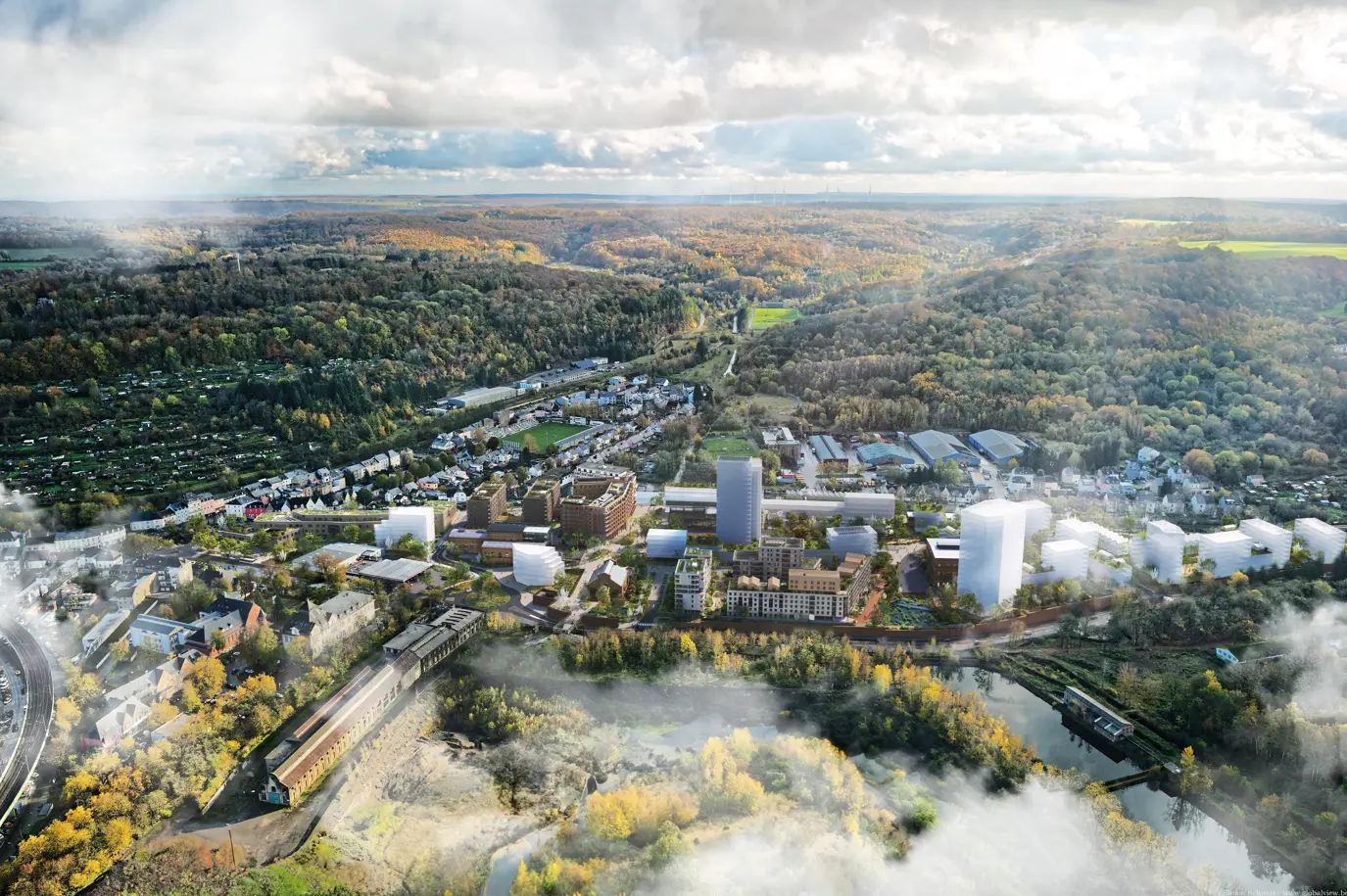
With Rout Lëns, IKO is transforming a former industrial site into a new neighbourhood in Esch-sur-Alzette. Could you outline the scale of the project in terms of area, homes and activities, and its delivery timeline?
Rout Lëns involves the transformation of a ten-hectare former industrial site in the south of Esch-sur-Alzette. Once complete, the neighbourhood will accommodate around 1,450 homes, alongside shops, workspaces and public amenities. These different uses are brought together by a strong identity rooted in the site’s industrial heritage, and by public spaces designed for social interaction, walking and everyday activities.
The project will be developed over ten to fifteen years, with the pace depending in particular on sales across the different phases. The first homes, around 200 in total, are being handed over by the spring, bringing the neighbourhood its first residents. It is very rewarding to see the project taking shape today.
Much remains to be done, however. We are involved across the entire process, from land acquisition and site development through to property development and investment in certain elements of the neighbourhood.
What does Rout Lëns mean to IKO, and to you personally?
This project has been part of my journey since I joined IKO in 2019. At the time, we were already working on the masterplan and the PAP, the detailed local development plan.
Rout Lëns has profoundly changed the way we approach residential and property development. Today, we increasingly act as an integrated urban developer, combining site development, property development and investment.
As a trained geographer and urban planner, this approach suits me well. We started with the site, its context, its relationship with the city and the needs the neighbourhood had to address. We then developed the solutions. This process has brought new skills into IKO. While Rout Lëns reflects the group’s values, it has also helped transform the company and the way we approach our work.
What makes the design of this neighbourhood distinctive?
We considered housing, energy, public spaces, mobility, health and inclusivity together. The Allée de la Culture Industrielle forms a pedestrian spine, with spaces for social interaction and activities arranged around it.
We also wanted to integrate art into the neighbourhood, with an artistic intervention on each development plot, taking a variety of forms. A city should be pleasant, beautiful and sometimes surprising. People should be able to enjoy wandering through it.
However, we did not innovate for innovation’s sake. We identified needs and sought appropriate responses. Some are simply common sense. Others required us to explore new solutions.
The energy concept is innovative too…
Yes. Through Callisto, developed as a joint venture with LuxEnergie and Encevo, we wanted to remain involved in the neighbourhood for several decades, beyond construction. This ambition stems from previous experience. We discovered that a building’s low energy consumption does not necessarily translate into correspondingly lower bills for residents, depending on the terms of energy supply. Yet infrastructure on this scale requires substantial investment, which few operators are willing to take on despite its long-term value. Rather than abandon the idea, we chose to become co-investors alongside partners with the necessary expertise. This means taking on additional risk and committing for the long term. For residents, however, the benefits lie in running costs and comfort: the system provides heating and cooling, with defined pricing terms. For us, it is also a selling point.
IKO stands out in the market for its innovation and environmental commitment. How do you maintain these ambitions in a challenging economic environment?
IKO has a strong DNA, shaped by Éric Lux: a determination to move forward, with a concern for occupants’ well-being and the environment. My role is to keep that spirit alive in a very different context from the one in which it developed. Upholding this commitment is central to our daily work and the way we operate as a team. We have specifications and core principles that we are committed to upholding, because our credibility is at stake. It is up to us to find solutions that allow us to deliver on them efficiently.
Reducing carbon emissions starts with the quantity of materials used. We scrutinise structural designs and component thicknesses, then the materials themselves and how they are used. In particular, we work with timber, prefabrication and material reuse.
These approaches do not always deliver immediate savings. Reclaiming materials can cost more than buying new ones. Prefabrication, however, can shorten construction times, improve working conditions and reduce financing costs during development. We have to look at the overall balance.
How has the housing crisis affected the project?
For Rout Lëns, there has been more than one crisis. The project as a whole has weathered several. We worked on the masterplan during the pandemic. That period highlighted the importance of housing quality, access to green spaces and local services. Health and inclusivity in public spaces also became particularly significant. We were able to incorporate these concerns into the neighbourhood’s design.
Then the war in Ukraine drove up energy and material prices. This reinforced some of our choices, particularly on energy, while imposing new economic constraints. Finally, we launched construction and sales just as the property market was entering a crisis.
We have therefore had to keep adapting: reviewing the mix of homes and uses, exploring construction solutions and strengthening our relationships with buyers. The challenge is to offer homes that remain financially accessible and in which residents can happily envisage their future.
The project addresses a need for housing, yet buyers are struggling to finance their purchases. How do you respond to this paradox?
The housing crisis we are experiencing prompted us to create an in-house sales team. We continue to work with agencies, but this closer relationship allows us to better understand expectations and support customers, particularly when explaining a neighbourhood-scale development or its energy system. It helps us find suitable solutions. Above all, these conversations inform our thinking on later phases of the project. We can review the mix of homes and uses, floor areas or certain construction choices to offer properties that meet market expectations.
The key issue remains the total cost of a home. Gaining extra floor space through a technical solution may seem attractive, but it also increases the purchase price. We have to strike the right balance between space, quality and what households can afford.
How do you see the role of property developers evolving in Luxembourg, particularly in light of market conditions?
The profession has already changed and will continue to evolve. Agility is essential, but the whole ecosystem must also adapt its practices: financing, land, design and sales are all interconnected.
Developers take on many risks, from land acquisition through to sales. Economic conditions must allow us to continue delivering homes, while demand remains substantial.
At IKO, we want to demonstrate that a commitment to the public interest can go hand in hand with profitability. The lessons learned at Rout Lëns are already informing other projects across the group. They also allow us to put this expertise to work for third-party clients: we now provide development management services on their behalf. As we move forward, our direction is clear: honour our core commitments while retaining the flexibility to adapt solutions as uses, technologies and needs evolve.