Read the full newsletter here
The Coque and the Philharmonie: When Architecture Becomes a Collective Symbol
Recognised at the latest LuxReal Real Estate Awards, the Coque and the Philharmonie are among Luxembourg's most iconic buildings. Beyond their architectural qualities, both projects have left a lasting mark on their era and helped shape the country's image. Together with representatives from the Administration des bâtiments publics and architects involved in their design and evolution, LuxReal explores the ingredients that transform a public building into a collective symbol.
At the latest edition of the Real Estate Awards, organised by LuxReal and Paperjam, two landmark public buildings were recognised for their contribution to Luxembourg's architectural heritage: the Coque in the "Iconic Building 1970–2000" category and the Philharmonie in the "Iconic Building 2000+" category.
But what makes certain buildings transcend their original function to become collective symbols? How does architecture contribute to a country's identity? And what exactly makes a building iconic?
To explore these questions, LuxReal brought together representatives of the Administration des bâtiments publics, Louis Reuter and Martine Schmitt, along with architects Sala Makumbundu and Dany Reinert from CBA Architects (CBA), the Luxembourg-based practice that partnered with Christian de Portzamparc on the Philharmonie and is currently involved in its extension.
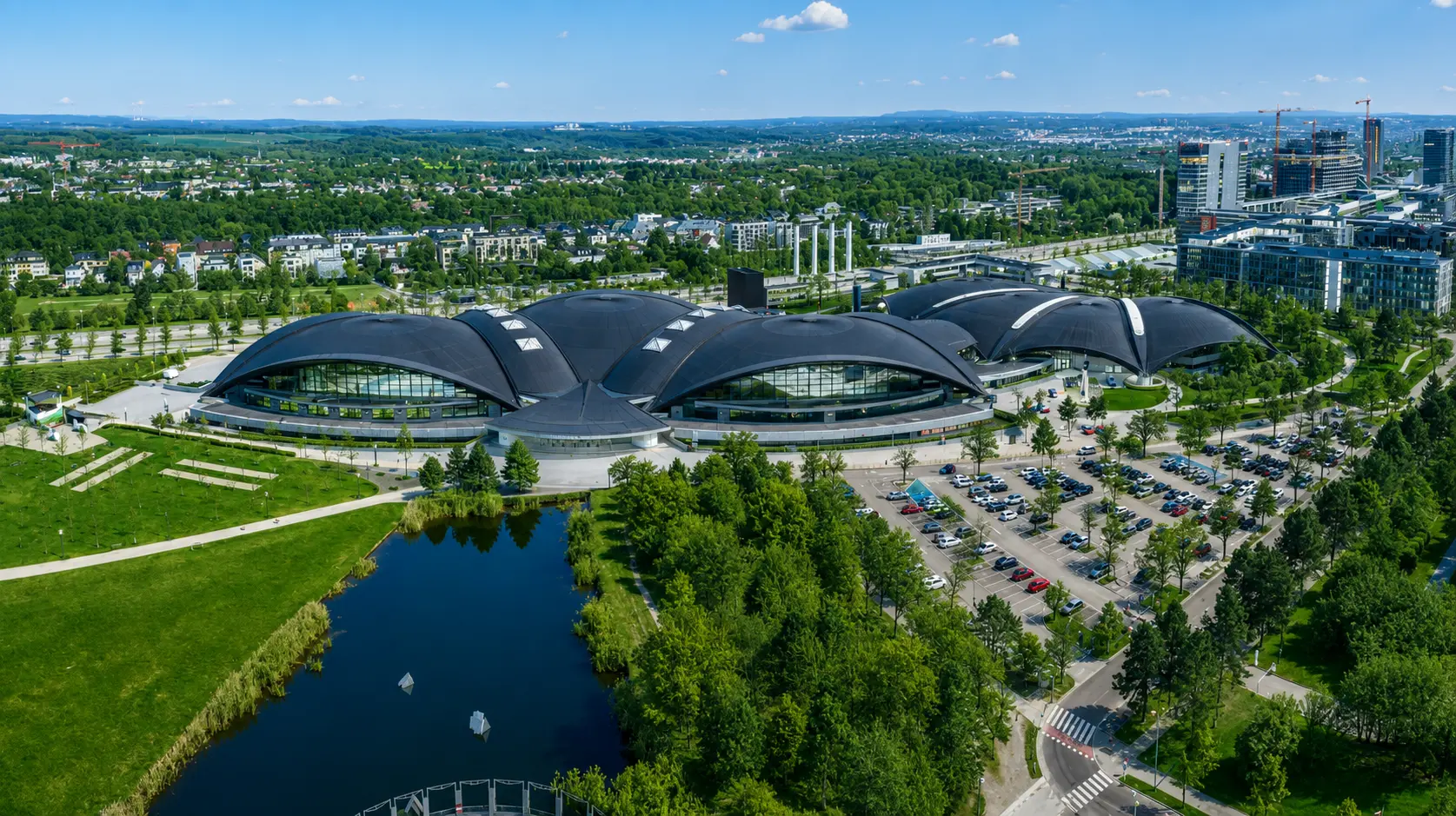
Coque
Best Iconic building - Years 1970 to 2000
Photo Credit: Claude Piscitelli
The Coque: An Ambitious Landmark Designed to Reach Beyond Luxembourg
Although the Coque and the Philharmonie stand only a short distance apart on the Kirchberg plateau, they reflect two very different moments in the district's history.
"The idea behind the Coque dates back to the late 1960s," explains Louis Reuter, Deputy Director of the Administration des Bâtiments Publics. "At the time, Gaston Thorn, then Minister of Physical Education and Sports, championed the creation of a modern sports centre that could serve as a reference point not only nationally, but throughout the Greater Region and internationally."
The choice of architect already reflected this ambition. Roger Taillibert, one of the world's leading specialists in sports infrastructure, was at the time working on the facilities for the Montreal Olympic Games.
The building that emerged on Kirchberg was spectacular. Its large prestressed concrete shells, unprecedented scale and state-of-the-art facilities immediately captured public attention.
"It was the event in Luxembourg," recalls Louis Reuter. "A building of that size, with that form and those facilities, had never been seen before. The whole country was talking about it."
The urban context reinforced this impression. In the 1970s, Kirchberg was still largely undeveloped.
"The building stood alone in the landscape," says Dany Reinert. "What is now Boulevard J.F. Kennedy was still a motorway, with virtually no surrounding buildings."
Finding a Place for the Philharmonie
The Philharmonie emerged in a radically different context.
When the international competition was launched in 1996, Kirchberg had already begun to take shape according to a carefully planned urban framework. The challenge was to create a building capable of supporting the international ambitions of the Luxembourg Philharmonic Orchestra while integrating into a complex urban environment.
"The urban context was completely different," recalls Dany Reinert. "The challenge was to find the building's place within a dense environment, surrounded by major buildings around Place de l'Europe and well-defined public spaces."
The objective was no longer to create a standalone landmark in an open landscape, but rather a building capable of engaging with its surroundings while asserting its own identity.
Nearly thirty years after the project was launched, the Philharmonie has become deeply embedded in Luxembourg's collective imagination. Its architectural concept undoubtedly played a major role in that process.
"Launching a competition for a concert hall with such demanding requirements naturally attracted some of the biggest names in architecture," says Martine Schmitt. " Bohdan Paczowski & Paul Fritsch, Claude Vasconi, Zaha Hadid, Jean Nouvel,… all participated. In the end, it was Christian de Portzamparc's proposal that prevailed."
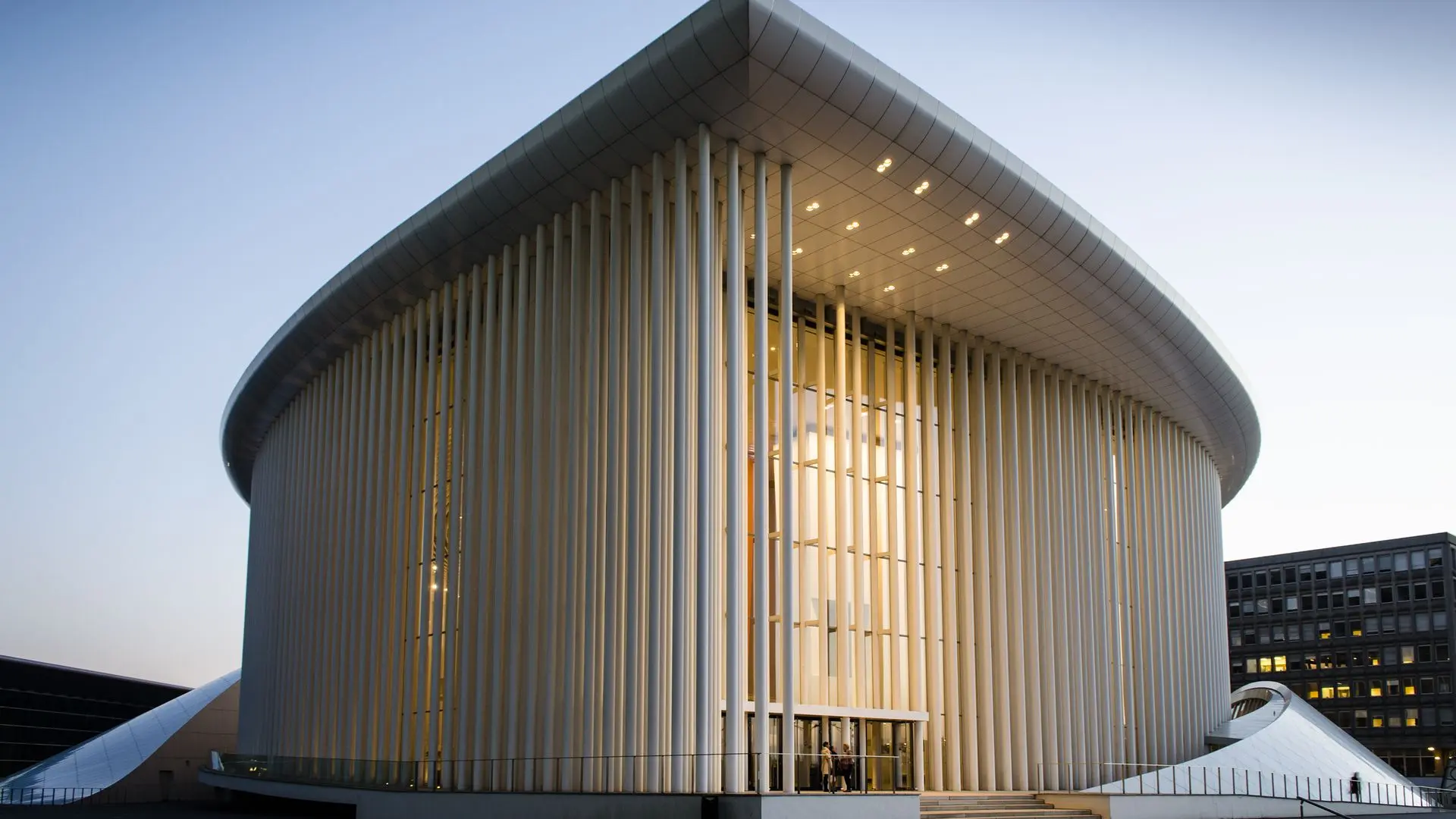
Philharmonie Luxembourg
Best Iconic building - Years 2000
Photo Credit: Thomas Lenaerts
Programme Comes First
Behind the building's exceptional architecture lies a rigorous programme and a long list of constraints.
"When designing a concert hall, acoustic performance is the absolute priority," explains Martine Schmitt, Head of New Construction Projects Division within the Administration des bâtiments publics. "The shape of the main hall was largely dictated by acoustic requirements. The 'shoebox' configuration, a rectangular format used in many of the world's leading concert halls, was part of the competition brief."
The genius of Christian de Portzamparc's design lies in its ability to transform this constraint into an architectural experience.
"What is remarkable is that you never actually perceive the box," explains Dany Reinert, Partner at CBA, who is involved in the implementation of the extension of the project. "Around this rigorously defined concert hall unfolds a succession of spaces, volumes and layers."
A Powerful Architectural Statement
The famous colonnade, which has become the building's signature feature, plays a central role.
"It acts as a transition between the city and the world of music," says Dany Reinert. "It creates a sense of calm, protection and almost intimacy before visitors enter the hall."
Martine Schmitt sees a more poetic dimension.
"Some people see a forest, others a musical score. The rhythm of the columns constantly changes. Light transforms the building throughout the day. That richness of interpretation contributes enormously to the strength of the project."
The Philharmonie is instantly recognisable and has become firmly anchored in the collective memory. In doing so, it has helped shape the country's image.
Twenty years after its inauguration, the Philharmonie has become far more than a concert hall. Featured on Luxembourg passports and regularly used in national tourism campaigns, it has established itself as one of the architectural symbols most closely associated with Luxembourg.
Iconicity Is Never the Objective
Yet creating an iconic building was never the original goal.
"At the outset, there was above all a desire for architectural quality," explains Martine Schmitt. "The objective was not to create a landmark. The objective was to deliver a good building and respond successfully to the programme."
For both the public authorities and the architects involved, successful architecture begins with finding the right answer to a specific need in a specific context.
"As architects, our goal is to find the right response to a programme and a place," says Sala Makumbundu, Partner at CBA. "The primary intention is to create a building that integrates naturally into its environment, fulfils its purpose and responds appropriately to the site's requirements. Seeing it become part of the public imagination is an immensely rewarding outcome."
Iconicity comes later, through time, through use and through the memories people attach to a place.
The Coque became the setting for major sporting events, international competitions and shared experiences for generations of Luxembourgers. The Philharmonie gradually established itself as one of the country's leading cultural symbols.
A Living Building
Twenty years after opening its doors, the Philharmonie continues to evolve.
The institution's success now extends far beyond the symphonic concerts for which it was originally conceived.
"Today, there are far more activities than originally anticipated," explains Martine Schmitt. "Conferences, youth programmes, educational activities, pre-concert and post-concert events... The building is used much more intensively than initially envisioned."
This evolution has led to a major extension project currently under construction.
If designing the original building was already a considerable challenge, adapting it without compromising its identity presents an even greater one.
"Buildings like this are normally very difficult to extend," acknowledges Dany Reinert. "The possibility of an extension was never envisaged at the outset."
The chosen solution consists largely of an intervention hidden beneath Place de l'Europe. The extension will provide a new foyer, a larger restaurant and flexible spaces designed to support the Philharmonie's evolving activities.
The Continuity of a Vision
One of the most remarkable aspects of the project is the continued involvement of Christian de Portzamparc himself.
"More than twenty years after completing the original building, the architect remains actively involved," says Louis Reuter. "We were fortunate that he is still working. For us, continuing the project with him was the obvious choice."
For the teams at CBA, long-standing partners on the project, this continuity is particularly valuable.
"It is a rare opportunity," says Sala Makumbundu. "It allows us to respond to new needs while remaining faithful to the original vision."
The extension does not seek to replicate the existing building but rather to extend its spirit.
"The materials, forms and colours all engage in dialogue with the original project," explains Dany Reinert. "The goal is for the extension to feel like a natural continuation."
Buildings That Stand the Test of Time
Ultimately, this ambition captures what makes these buildings so powerful: their ability to evolve without losing their identity.
While the Coque and the Philharmonie belong to different generations, they share a common quality. Both embody a strong public ambition and an architectural vision capable of transcending their original function to become collective landmarks.
A rare achievement—one that explains why, decades after their inauguration, they continue to represent an important part of Luxembourg's image.
French version
La Coque et la Philharmonie : quand l'architecture devient un symbole collectif
Récompensées lors des derniers Real Estate Awards de LuxReal, la Coque et la Philharmonie figurent parmi les bâtiments les plus emblématiques du Luxembourg. Au-delà de leurs qualités architecturales, ces deux réalisations ont marqué leur époque et contribué à façonner l'image du pays. Avec l'Administration des bâtiments publics et les architectes impliqués dans leur conception et leur évolution, retour sur les ingrédients qui transforment un bâtiment public en symbole collectif.
Lors de la dernière édition des Real Estate Awards, organisés par LuxReal et Paperjam, deux bâtiments publics emblématiques ont été distingués pour leur contribution au patrimoine architectural luxembourgeois : la Coque, dans la catégorie « Iconic Building 1970–2000 », et la Philharmonie, dans la catégorie « Iconic Building 2000+ ».
Mais, au fait, pourquoi certains édifices dépassent-ils leur fonction première pour devenir des symboles collectifs ? Comment l'architecture participe-t-elle à l'identité d'un pays ? Qu’est-ce qui fait l'iconicité d'un bâtiment ? Pour en parler, LuxReal a réuni des représentants de l'Administration des bâtiments publics, Louis Reuter et Martine Schmitt, ainsi que des membres du bureau d'architecture CBA Architects (CBA), Sala Makumbundu et Dany Reinert, partenaire historique de Christian de Portzamparc sur le projet de la Philharmonie et aujourd'hui impliqué dans son extension.
Coque
Best Iconic building - Years 1970 to 2000
Photo Credit: Claude Piscitelli
La Coque, un bâtiment emblématique pour rayonner largement
La Coque et la Philharmonie sont quasiment voisines sur le plateau du Kirchberg. Pourtant, elles racontent deux moments très différents de l'histoire de ce quartier. « L'idée de la Coque remonte à la fin des années 1960, commente Louis Reuter, directeur adjoint de l’Administration des bâtiments publics. Gaston Thorn, alors ministre de l'Éducation physique et des Sports, défend l’idée de créer un centre sportif moderne, capable d'être une référence au niveau national, dans la Grande Région et même à l'international. »
Le choix d’architecte, Roger Taillibert, alors considéré comme l'un des grands spécialistes mondiaux des infrastructures sportives, témoigne déjà de cette ambition. À l'époque, l'architecte travaille notamment sur les installations olympiques de Montréal.
« Le bâtiment qui émerge sur le Kirchberg est spectaculaire. Avec ses grandes coques de béton précontraint, ses dimensions inédites et ses équipements sportifs de premier plan, il marque les esprits. C'était l'événement au Luxembourg, se souvient Louis Reuter. Un bâtiment d'une telle dimension, avec cette forme, et puis aussi ces infrastructures, cela n'avait jamais été vu auparavant. Tout le pays en parlait. »
Le contexte urbain contribue lui aussi à cette impression. Dans les années 1970, le Kirchberg est encore largement vide. « Le bâtiment était alors isolé dans le paysage, résume Dany Reinert. L’actuel Boulevard JF Kennedy était encore une autoroute, sans immeubles autour. »
Permettre à la Philharmonie de trouver sa place
La Philharmonie, elle, naît dans un environnement radicalement différent. En 1996, au moment ou un concours international lié au développement de ce lieu est lancé, le Plateau du Kirchberg s’est alors structuré autour d’un plan précis. Tout l’enjeu était de parvenir à intégrer au mieux ce projet devant soutenir le rayonnement de l’Orchestre Philharmonique de Luxembourg. « Le contexte urbanistique était complètement différent, rappelle Dany Reinert. Ici, il fallait trouver sa place dans un environnement complexe, entouré de bâtiments importants au niveau de la Place de l’Europe et d'espaces publics déjà définis. »
L'enjeu n'est plus de créer un signal isolé dans le paysage, mais de concevoir un bâtiment capable de dialoguer avec son environnement tout en affirmant sa propre identité.
Près de 30 ans après le lancement du projet, la Philharmonie est désormais associée au Luxembourg dans l’imaginaire collectif. Et, son concept architectural y est certainement pour beaucoup. « Faire un concours pour une salle de concert avec un programme aussi exigeant a naturellement attiré les plus grands architectes comme Bohdan Paczowski & Paul Fritsch, Claude Vasconi, Zaha Hadid, Jean Nouvel, … rappelle Martine Schmitt. C’est finalement le projet de Christian de Portzamparc qui s’impose dans le cadre du concours. »
Philharmonie Luxembourg
Best Iconic building - Years 2000
Photo Credit: Thomas Lenaerts
Le programme avant tout
Il est toutefois important de préciser que, derrière l’exceptionnelle architecture du bâtiment, se cache d’abord un programme rigoureux et que les contraintes étaient nombreuses.
« Lorsque l’on développe une salle de concert, la qualité acoustique constitue la priorité absolue, commente Martine Schmitt, responsable au sein de la Division des travaux neufs de l’Administration des bâtiments publics. La forme de la salle était largement imposée par les contraintes en la matière. Le principe de la « shoebox », cette forme rectangulaire utilisée dans les grandes salles symphoniques, faisait partie du cahier des charges. »
Le génie du projet imaginé par Christian de Portzamparc réside précisément dans sa capacité à transformer cette contrainte en expérience architecturale. « Ce qui est remarquable, c'est qu'on ne perçoit jamais cette boîte, explique Dany Reinert, associé du bureau d’architecte CBA, qui accompagne l’exécution de l’extension du projet. Autour de cette salle aux proportions rigoureusement définies, se déploie une succession d'espaces, de volumes et de filtres. »
Un signal architectural fort
La célèbre colonnade, devenue la signature du bâtiment, joue un rôle essentiel. « Elle agit comme une transition entre la ville et l'univers de la musique, poursuit Dany Reinert. Elle crée une forme de calme, de protection, presque d'intimité avant l'entrée dans la salle. »
Martine Schmitt y voit également une dimension plus poétique. « Certains y voient une forêt, d'autres une partition musicale. Le rythme des colonnes change constamment. La lumière transforme le bâtiment au fil de la journée, décrit-elle. Cette richesse d'interprétation contribue largement à la force du projet. »
Au final, la Philharmonie est directement reconnaissable et, dès lors, s’ancre dans nos mémoires… pour, au final contribuer à l’image du pays. Vingt ans après son inauguration, la Philharmonie est devenue bien plus qu'une salle de concert. Reprise sur les passeports luxembourgeois, omniprésente dans les campagnes de promotion du pays, elle s'est imposée comme l'un des symboles architecturaux les plus immédiatement associés au Luxembourg.
L'iconicité n'est jamais un objectif
La volonté première n’était cependant pas de faire des bâtiments iconiques. « Je pense que, au départ, il y avait avant tout une volonté de qualité architecturale, explique Martine Schmitt. L'objectif n'était pas de créer un bâtiment emblématique. L'objectif était de réaliser un bon bâtiment et de répondre au programme. »
Pour les représentants de l’administration des bâtiments publics comme pour les architectes, la réussite d’un projet naît d'abord de la capacité à apporter la bonne réponse à un besoin précis, dans un contexte donné. « Notre recherche en tant qu'architectes, c'est de trouver la juste réponse à un programme et à un lieu, explique Sala Makumbundu, associée du cabinet CBA. L'intention première est de créer un bâtiment qui s'intègre bien, qui soit à la hauteur du programme et qui réponde aux exigences du site. Qu’il s’intègre naturellement dans son environnement et, plus encore, dans l’esprit du public, constitue une grande satisfaction vis-à-vis de notre travail. »
L'iconicité vient ensuite, avec le temps, avec l'appropriation du bâtiment par ses usagers, avec les souvenirs qui s'y attachent. La Coque est devenue le lieu de grands événements sportifs, de compétitions internationales, mais aussi de souvenirs partagés par plusieurs générations de Luxembourgeois. La Philharmonie, quant à elle, s'est progressivement imposée comme l'un des symboles culturels du pays.
Un bâtiment vivant
Vingt ans après son inauguration, la Philharmonie continue pourtant d'évoluer.
L'institution connaît aujourd'hui un succès qui dépasse largement le cadre des concerts classiques pour lesquels elle avait été conçue. « Il y a aujourd'hui beaucoup plus d'activités que ce qui avait été imaginé à l'origine, explique Martine Schmitt. Des conférences, des événements pour les jeunes, des rencontres avant ou après les concerts, des activités pédagogiques... Le bâtiment est utilisé de manière beaucoup plus intensive qu'au départ. »
L’évolution des besoins a conduit au lancement d'un projet d'extension actuellement en cours. Si la conception originelle constituait déjà un défi important, parvenir à le faire évoluer est un challenge plus grand encore. Comment transformer un bâtiment devenu emblématique sans altérer son identité ? « Ce type de bâtiment est normalement très difficile à étendre, reconnaît Dany Reinert. Au départ, il n'était pas du tout prévu qu'il fasse l'objet d'une extension. »
La solution retenue repose sur une intervention largement dissimulée sous la Place de l'Europe. Le projet accueillera notamment un nouveau foyer, un restaurant plus généreux et des espaces polyvalents destinés à accompagner l'évolution des usages.
La continuité d'une vision
ntinuité d'une vision
Pour envisager cette extension, l’Administration publique a eu la chance de pouvoir compter sur la participation directe de Christian de Portzamparc lui-même. « Plus de vingt ans après la réalisation du bâtiment original, l'architecte continue de suivre le projet, commente Louis Reuter. Nous avons eu la chance que l'architecte soit toujours actif. Pour nous, il était évident de poursuivre l'aventure avec lui. »
Pour les équipes de CBA, partenaires historiques du projet, cette continuité est particulièrement précieuse. « C'est une occasion rare, confie Sala Makumbundu. Elle nous permet de répondre à de nouveaux besoins tout en restant fidèles à l'intention initiale. »
Aussi, le projet architectural mis en œuvre vient prolonger l’esprit qui prévalait jusqu’alors. « Les matériaux, les formes, les couleurs, tout cela dialogue avec le projet original, explique Dany Reinert. L'idée est que l'extension apparaisse comme une continuité naturelle. »
Des bâtiments qui traversent le temps
Une ambition qui résume finalement ce qui fait la force de ces bâtiments emblématiques : leur capacité à traverser le temps sans perdre leur identité.
Car si la Coque et la Philharmonie appartiennent à deux générations différentes, elles partagent une même qualité. Toutes deux témoignent d'une ambition publique forte et d'une architecture capable de dépasser sa fonction première pour devenir un repère collectif.
Une qualité suffisamment rare pour que, plusieurs décennies après leur inauguration, elles continuent d'incarner une part de l'image du Luxembourg.
Back to the full newsletter here